
 Khizrana Begum
Health & Wellness Writer
Khizrana Begum is a health and wellness writer
focused on clear, practical, and reader-friendly
health, nutrition, fitness, and lifestyle content.
Read Full Bio of Author →
 Sameena Begum
Health, Wellness & Digital Content Reviewer
Sameena Begum reviews health, wellness, fitness, nutrition, and digital content for clarity, factual presentation, consistency, and reader usefulness.
Read Full Bio of Reviewer →
 Dr. Syed Imtiaz
General Physician & Dermatologist
Dr. Syed Imtiaz is an MBBS and MD qualified
medical professional with 5+ years of experience
in general medicine and dermatology.
Read Full Bio of Medical Reviewer →
Peptides for Tendon and Joint Recovery: The Science Behind Recovery Peptides BPC-157 and TB-500 in Canada
Sometimes an injury might cost a Canadian athlete more than simply one less day of practice. Canadians aren’t new to slippery sidewalks, a long extended winter, manual labor jobs and wanting to be active. There’s not much motivation to work out when that sore knee keeps you from that walk each day, or the tight shoulders prevent you from heading to the gym. This is where recovery peptides such as BPC-157 and TB-500 have attracted attention. But it’s crucial to understand how much of their promise is supported by scientific evidence.
BPC-157 and TB-500: What Does the Evidence Actually Show?
BPC-157 and TB-500 and are fairly common in sports recovery, but they are still being researched given the science.
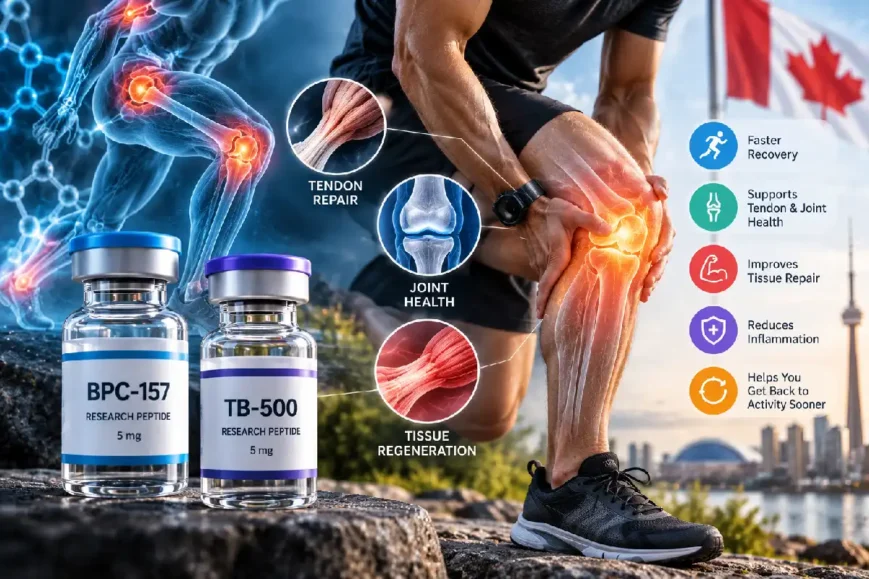
The BPC-157: This substance has mostly been studied in preclinical experiments and has been hypothesized to help heal tissue and promote blood vessel growth in animal studies. Their potential continues to drive interest in more critical human clinical trials. You can contact a reliable bpc-157 capsules canada store, choose your quantity and place an order.
TB-500: Used in investigation of thymosin beta-4 and other related processes, this compound is marketed for tissue recovery. Its biological potential centers in its ability to change shape and migrate toward damaged tissue rapidly to initiate repair. Also, preclinical studies suggest it downregulates pro-inflammatory effects, helping to resolve chronic swelling and reduce scar tissue formation during recovery
It may seem logical to try to time both together to allow you to do both repair processes in a single step, but using single peptides is crucial for precision assessments and ease of trouble shooting in case of undesired effects.
With injured athletes, it’s a different matter: a hopeful experiment in the lab is not a validated treatment.
Why Tendon and Joint Pain Last Longer than Muscle Soreness
Muscle aches tend to wear off after a strenuous workout, but one can significantly settle back in a matter of days. On the other hand, tendon pain can last for weeks or months, especially if the tissue continues to be subjected to strain.
Part of the answer lies in blood supply. Tendons, for example, have much poorer blood supply than many muscles, and of course cartilage has virtually no ability to repair itself. All of these tissues also rely heavily on a structural protein called collagen to absorb the repeated loading or movement.
And because some peptides can stimulate cellular behavior known to assist tissue repair, these short chain amino acids are emerging as an increasingly important focal point of sports recovery research. Research suggests peptides can tell cells to generate collagen and other structural elements of the extracellular matrix.
Peptides assist deliver a tailored therapy plan targeting the biological root causes, not just another device that will assist you get back on your feet quicker.
Canadian Quality Standards: A Lot More than Just Testing for Purity
For Canadian testing laboratories working with peptides, documentation can be very important. Product labels will not be able to prove chemical identity or purity or that the product is appropriate for a specific research application.
A CoA specific to the batch may include details of the properties of a sample that were tested for. For example, purity, molecular identity can be checked by a method such as high-performance liquid chromatography (HPLC) or mass spectrometry, depending on what testing is done, but the usefulness of this depends on the report.
When reviewing supplier documentation, one should examine:
- A report that specifies identity and composition of the compound that is being tested and the characteristics of it that are being measured.
- Traceability of batches: Is the lot number consistent with the documentation?
- Is it covered in enough detail? For example, does the report: Describe how tests were performed and what the results were?
- Regulatory status: Is the product authorized in Canada for its intended use?
Just because the result is high-purity, it does not mean that the compound is safe or effective for treatment of an injury. Canadian regulations still count for something, at least when it comes to products that are used on humans.
Shipping and Storage Across Canada: Why Handling is Important
A shipment moving between Toronto, Montréal, Calgary and Vancouver is subject to different processes along the route. Certain peptides are susceptible to moisture, temperature and other elements. Some drugs may be more stable after freeze-drying but this does not safeguard all products. Storage conditions vary by product and are subject to validated manufacturer’s instructions.
The receiving procedure for legitimate laboratory work should have package integrity checks, lot checks, transportation condition checks as applicable and noting of anomalies. The storage condition should be in line with the licensed requirements of the product and not a blanket temperature lock.
They can ensure quality but they cannot address a lack of certainty regarding what a product is or where the safety data leaves us.
In essence, the potential of peptide therapies has the potential to provide a much-needed, breakthrough innovation to allow the body to kickstart a natural rebuild and repair system to the injured tendons. Peptides don’t hijack the body into thinking and acting in unnatural ways – rather they simply signal the biological instructions to activate those target cells to tell them how to repair and rebuild.
But rational decision-making must go beyond enticing mechanism of action and assertions made by suppliers. Accessing safe treatments in Canada necessitates separating the experimental from the approved product, and relying on solid evidence, informed health professionals and realistic projections for joint function and durability.
Khizrana Begum creates clear and reader-friendly content covering health, wellness, nutrition, fitness, and healthy lifestyle topics.
View Author Profile →
Sameena Begum reviews health, wellness, fitness, nutrition, and digital content for clarity, factual presentation, consistency, and reader usefulness.
View Reviewer Profile →
Dr. Syed Imtiaz is an MBBS and MD qualified medical professional with 5+ years of experience in general medicine and dermatology.
View Medical Reviewer Profile →