
 Khizrana Begum
Health & Wellness Writer
Khizrana Begum is a health and wellness writer
focused on clear, practical, and reader-friendly
health, nutrition, fitness, and lifestyle content.
Read Full Bio of Author →
Khizrana Begum
Health & Wellness Writer
Khizrana Begum is a health and wellness writer
focused on clear, practical, and reader-friendly
health, nutrition, fitness, and lifestyle content.
Read Full Bio of Author →
 Sameena Begum
Health, Wellness & Digital Content Reviewer
Sameena Begum reviews health, wellness, fitness, nutrition, and digital content for clarity, factual presentation, consistency, and reader usefulness.
Read Full Bio of Reviewer →
Sameena Begum
Health, Wellness & Digital Content Reviewer
Sameena Begum reviews health, wellness, fitness, nutrition, and digital content for clarity, factual presentation, consistency, and reader usefulness.
Read Full Bio of Reviewer →
 Dr. Syed Imtiaz
General Physician & Dermatologist
Dr. Syed Imtiaz is an MBBS and MD qualified
medical professional with 5+ years of experience
in general medicine and dermatology.
Read Full Bio of Medical Reviewer →
Dr. Syed Imtiaz
General Physician & Dermatologist
Dr. Syed Imtiaz is an MBBS and MD qualified
medical professional with 5+ years of experience
in general medicine and dermatology.
Read Full Bio of Medical Reviewer →
When Should You See a Neurologist? 10 Symptoms You Shouldn’t Ignore
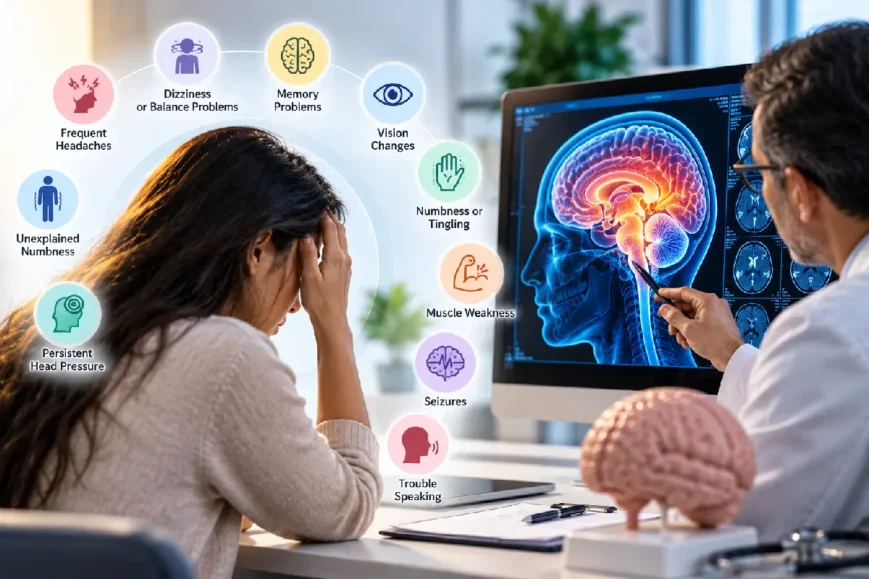
Neurological symptoms can be difficult to recognize because the nervous system is involved in so many bodily functions. A headache, a tingling hand or a moment of dizziness is often harmless, yet the same symptom can sometimes point to a problem involving the brain, spinal cord, nerves or muscles. Many of these symptoms also overlap with conditions that have nothing to do with the nervous system, such as dehydration, medication side effects or inner-ear problems.
This article explains which neurological symptoms may justify seeing a neurologist, what kinds of causes are possible and when a symptom should be treated as an emergency. It is general education and cannot diagnose anyone. Most of these symptoms have several possible causes, and the purpose of an evaluation is to find out which one applies.
WHAT DOES A NEUROLOGIST TREAT?
A neurologist is a doctor who diagnoses and manages conditions of the brain, spinal cord, peripheral nerves (the nerves outside the brain and spinal cord), muscles and the connections between nerves and muscles. Common examples include migraine, epilepsy, neuropathy, Parkinson’s disease, multiple sclerosis and conditions related to stroke.
Neurologists generally focus on diagnosis and non-surgical treatment. If surgery is needed, they refer patients to a neurosurgeon.
10 SYMPTOMS THAT DESERVE ATTENTION
1. Persistent or Severe Headaches
Most headaches are not dangerous. Tension-type headaches and migraines are common and often respond to treatment. A neurologist can help when headaches are frequent, keep getting worse, change in pattern or interfere with daily life.
Headaches can also be secondary, meaning they are caused by another condition. Pay attention if a headache comes with vision problems, vomiting, weakness or other neurological symptoms, or if it is triggered or worsened by coughing, sneezing or bending down. A sudden, extremely severe headache is different and needs emergency care.
2. Dizziness or Recurrent Vertigo
Dizziness is a broad term for feeling lightheaded or unsteady. Vertigo is more specific: a spinning sensation, as though you are moving or the room is moving around you. Inner-ear conditions are the most common cause of vertigo, but migraine, medications and, less often, problems in the brain or nerves can also be involved.
Recurring or unexplained dizziness, especially if it affects daily activities, is a good reason to see a doctor. Dizziness together with double vision, trouble speaking or weakness is an emergency.
3. Numbness or Tingling
Occasional tingling after sitting in an awkward position is normal. Numbness or tingling that is persistent, spreading or unexplained is worth raising with a doctor. When it affects the hands and feet, peripheral neuropathy (damage to the nerves outside the brain and spinal cord) is one possibility. Diabetes, vitamin deficiencies, infections and some medications are among the known causes.
Sudden numbness on one side of the body is different. It can be a sign of stroke and requires emergency care.
4. Muscle Weakness
Feeling tired is not the same as true weakness, which means difficulty lifting an arm, gripping an object or climbing stairs despite effort. Weakness that is persistent, gets worse over time or affects one limb or one side of the body is worth having checked. Causes range from nerve compression to muscle conditions to disorders of the brain or spinal cord. Sudden weakness on one side is an emergency.
5. Fainting or Unexplained Loss of Consciousness
Many fainting episodes have simple triggers, such as standing up too quickly, dehydration, heat or emotional distress. But fainting can also be linked to heart problems, medications or neurological and metabolic conditions. Recurrent or unexplained fainting should be assessed by a doctor. Depending on the circumstances, you may need cardiovascular assessment or a neurological evaluation, particularly if a seizure is suspected.
6. Seizures
A seizure is a burst of abnormal electrical activity in the brain. It does not always look like the dramatic shaking most people picture. Some seizures cause a brief loss of awareness, staring, odd sensations or small repeated movements. Others cause stiffening, falling or full-body jerking.
Anyone who has a first seizure needs medical evaluation. Call emergency services for a first seizure, a seizure lasting longer than usual for that person, or more than five minutes if their usual duration is unknown, or repeated seizures without recovery between them.
7. Tremors or Other Abnormal Movements
A slight tremor is normal, and stress, fatigue, caffeine and some medications can make it more noticeable. A tremor that worsens or interferes with writing, eating or other daily tasks is worth having examined, as are involuntary movements, stiffness or movements that seem slower than before.
Parkinson’s disease is one possible cause of these changes, but it is far from the only one. Essential tremor, medication effects and thyroid problems are among the others, which is why an examination matters.
8. Memory or Cognitive Changes
Everyone forgets a name or misplaces keys. It is worth seeing a doctor when memory lapses are persistent, noticeably worse than before or accompanied by confusion, trouble concentrating, difficulty with familiar tasks or changes in language and problem-solving. Many things besides dementia can affect memory, including depression, sleep problems, medication effects and vitamin deficiencies, so evaluation often looks at several possibilities.
Gradual changes can be assessed through a routine appointment. Sudden confusion needs immediate medical assessment.
9. Balance or Coordination Problems
Frequent falls, unsteady walking, clumsiness or difficulty with tasks that used to be easy can have neurological causes, but also inner-ear, medication-related, vision-related or other causes. Because falls can cause injury, it is sensible to have repeated problems checked rather than waiting. Sudden severe loss of balance, particularly with other stroke signs, is an emergency.
10. Vision or Speech Changes
Double vision, sudden changes in vision, slurred speech and trouble finding or understanding words can all have neurological causes. Sudden speech or vision changes can be signs of stroke and require emergency care. Do not wait to see whether they pass.
WHEN NEUROLOGICAL SYMPTOMS ARE AN EMERGENCY
Some symptoms should not wait for a routine appointment. Call your local emergency number right away for:
- Sudden weakness or numbness, especially on one side of the body
- Sudden trouble speaking or understanding speech
- Sudden vision loss or double vision
- Sudden severe loss of balance
- A first seizure, a seizure lasting longer than usual for that person (or more than five minutes if their usual duration is unknown), or repeated seizures without recovery between them
- Sudden confusion
- Loss of consciousness that does not quickly resolve
- A sudden, extremely severe headache
- New neurological symptoms after a major head injury
Stroke warning signs are often remembered with the acronym FAST: Face drooping, Arm weakness, Speech difficulty and Time to call emergency services. Some health agencies add Balance and Eyes (BE FAST) to cover sudden dizziness or loss of coordination and vision changes.
Do not drive yourself or someone else if a stroke is suspected, because ambulance crews can begin care on the way. Note the time symptoms started, since this helps doctors choose treatment. Symptoms that go away within minutes can still signal a transient ischemic attack (a “mini-stroke”) and need urgent assessment.
WHAT HAPPENS DURING A NEUROLOGICAL EVALUATION?
A visit usually starts with a conversation. The neurologist asks what the symptoms feel like, when they began, how often they occur, what makes them better or worse, and which medications and medical conditions are relevant. A clear description, including timing, can be as useful as any test.
A neurological examination follows. It typically checks reflexes (often with a small rubber hammer), muscle strength, sensation, balance, coordination and walking. Memory, attention and thinking may be assessed when relevant.
Depending on what the examination suggests, further testing may be recommended. This can include MRI or CT of the brain or spine, blood tests, electroencephalography (EEG), which records the brain’s electrical activity, or nerve-conduction studies, which measure how well nerves carry signals. Many people need only some of these tests, and some need none.
Neurological diagnosis can also involve more than one specialty. Hospitals with multiple specialties, such as Samitivej Hospital in Bangkok, can coordinate neurological care with diagnostic imaging, emergency medicine and other services when symptoms involve more than one system.
FAQ
Do I need a referral to see a neurologist?
It depends on the country, hospital and insurance plan. Some systems require a referral from a primary care doctor, while others allow patients to book directly. Checking with the clinic or insurer first can save time.
Can stress cause neurological symptoms?
Stress and anxiety can cause or worsen symptoms such as headaches, tremor and dizziness, and those symptoms are real. But the same symptoms can have other causes, so a doctor should rule out other explanations rather than assume stress is responsible.
Should I see a neurologist for headaches?
Many people with occasional headaches do not need one. A neurologist is more likely to help when headaches are frequent, severe, changing or resistant to treatment. Headaches with weakness, vision or speech changes, or after a head injury, need urgent attention.
What is the difference between a neurologist and a neurosurgeon?
A neurologist diagnoses and manages neurological conditions, usually with medication and other non-surgical treatments. A neurosurgeon performs surgery on the brain, spine and nerves. Patients often see a neurologist first, who refers them to a neurosurgeon if surgery may help.
What tests might a neurologist order?
It depends on the symptoms. Options include MRI, CT, EEG, nerve-conduction studies, blood tests and, in some cases, a lumbar puncture to examine spinal fluid. Your neurologist will explain why a particular test is being recommended.
Khizrana Begum creates clear and reader-friendly content covering health, wellness, nutrition, fitness, and healthy lifestyle topics.
View Author Profile →
Sameena Begum reviews health, wellness, fitness, nutrition, and digital content for clarity, factual presentation, consistency, and reader usefulness.
View Reviewer Profile →
Dr. Syed Imtiaz is an MBBS and MD qualified medical professional with 5+ years of experience in general medicine and dermatology.
View Medical Reviewer Profile →